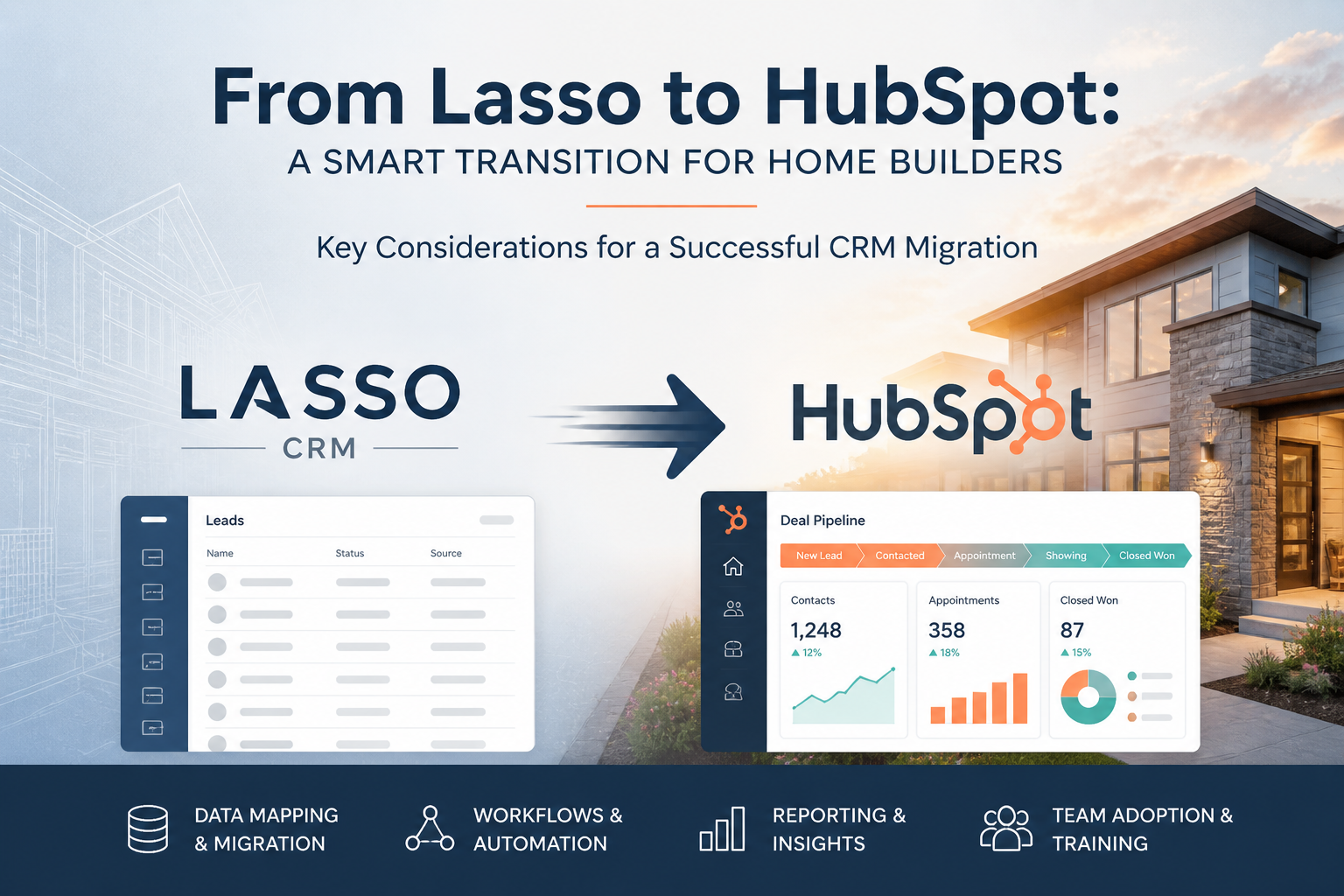
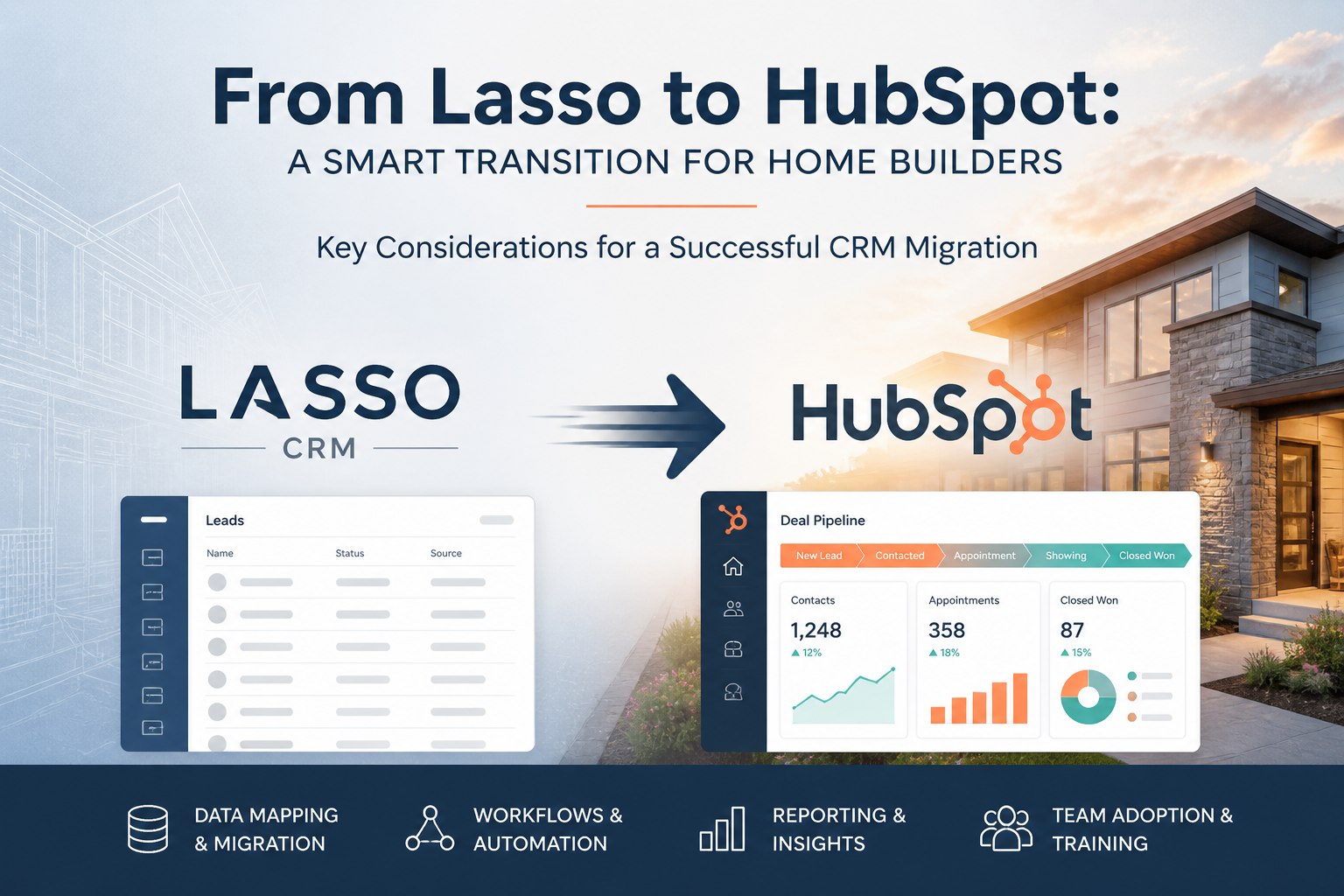
 For many home builders, Lasso has served as a dependable CRM for years. It has been a foundational system for lead management, prospect tracking, and sales processes. But as builder operations evolve, marketing becomes more sophisticated, and data expectations increase, many organizations are exploring the move to HubSpot.
A Lasso to HubSpot transition is not simply a software swap. It is an opportunity to modernize your entire sales, marketing, and customer journey infrastructure.
Why Builders Are Making the Move
HubSpot offers several advantages that often drive this shift:
Unified sales and marketing platform
HubSpot combines CRM, marketing automation, email, reporting, content management, and AI tools into one ecosystem.
Improved automation
Advanced workflows can automate lead routing, nurture sequences, appointment management, internal notifications, and buyer journey stages.
Better reporting and dashboards
HubSpot’s reporting flexibility allows builders to track community performance, OSC effectiveness, conversion rates, marketing ROI, and full funnel sales performance more clearly.
Scalability
As builders grow into multiple divisions, regions, and product lines, HubSpot can better support complex operational structures.
Key Considerations Before Transitioning
1. Data Mapping Is Critical
Lasso and HubSpot structure data differently.
You need to carefully map:
- Contacts
- Leads
- Sales counselors
- Communities
- Realtors
- Appointments
- Notes
- Lead sources
- Custom questions
- Prospect ratings
- Sales stages
Common challenges:
- Duplicate records
- Inconsistent lead source naming
- Missing community associations
- Historical activity formatting
- Opt-out compliance
- Realtor relationship tracking
A poorly planned migration can create long-term reporting issues.
2. Historical Data Strategy
Not all historical data should move exactly as-is.
Consider:
- Which notes and activities are essential
- Whether old tasks should be archived
- How appointments are handled
- Which custom fields need to be recreated
- Which data should remain in BigQuery or data warehouse systems instead of cluttering CRM
Many builders benefit from moving core sales data into HubSpot while maintaining deeper historical archives externally.
3. Community and Division Structure
HubSpot often requires a more thoughtful property architecture.
Important decisions include:
- Single-select vs multi-select community fields
- Division of interest
- Region segmentation
- Community lifecycle
- Inventory associations
- Family or household grouping
- Realtor partner relationships
Getting this right upfront avoids future operational rework.
4. Lead Routing and Sales Workflows
Lasso users are often accustomed to existing lead assignment logic.
HubSpot implementation should address:
- OSC rotation
- Sales rep assignment
- Appointment scheduling
- Lead reassignment
- Walk-in registrations
- Web registrations
- Realtor submissions
- Self-service scheduling
This is often where HubSpot creates the biggest performance gains.
5. Website Forms and Community Attribution
One of the biggest technical shifts involves website registration.
Builders should decide:
- Separate forms per community
- Universal form with hidden community field
- URL-based community detection
- Progressive profiling
- Sales center kiosk forms
- Realtor registration pathways
This directly impacts reporting quality and lead attribution.
6. Marketing Contact Management
HubSpot pricing is often influenced by marketing contacts.
Builders need strategies for:
- Active vs inactive contacts
- Lead nurture segmentation
- Past prospects
- Realtors
- Vendors
- Homeowners
- Suppression lists
Without proper planning, costs can rise unnecessarily.
7. Integration Requirements
Review all systems connected to Lasso today:
- Website providers
- Call tracking
- SMS platforms
- ERP systems
- Inventory feeds
- Google Ads
- Meta Ads
- Reporting dashboards
- BigQuery
- Sales center tools
A transition should include a full integration audit.
8. Training and Change Management
Technology alone does not ensure adoption.
Sales teams need:
- Dashboard training
- Pipeline stage training
- Lead management expectations
- Email sequence training
- Appointment tools
- Reporting visibility
- OSC best practices
Strong onboarding is essential for ROI.
Final Thought
A Lasso to HubSpot migration is one of the most impactful operational upgrades a builder can make, but only if approached strategically.
Builders who succeed typically focus on:
- Clean data architecture
- Thoughtful workflow design
- Reporting consistency
- Team adoption
- Scalability
HubSpot can dramatically improve conversion, visibility, and operational efficiency, but success depends on building the right foundation from day one.
Bottom Line:
A successful migration is not just about moving data. It is about redesigning your builder sales and marketing engine for long-term growth.
