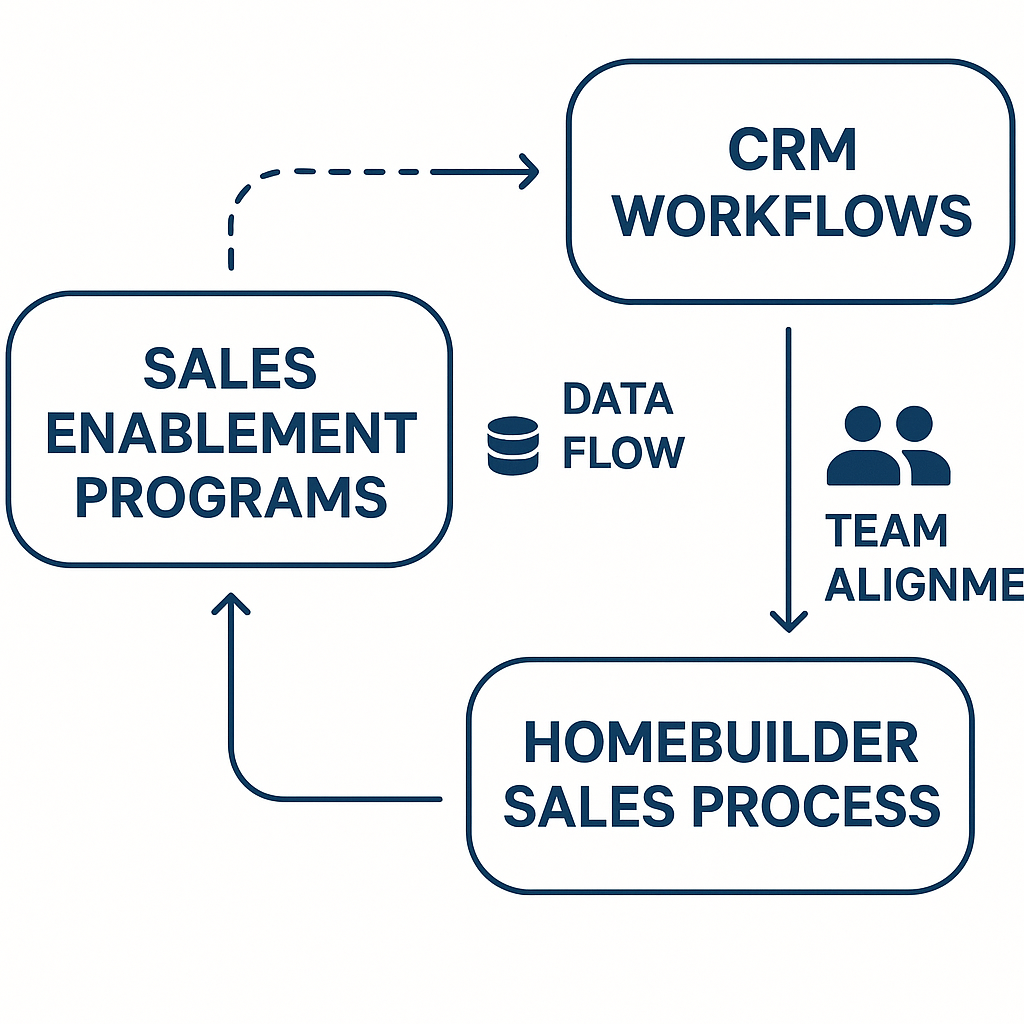
When sales enablement operates independently from your actual sales process, teams struggle with adoption, leadership loses visibility, and conversion opportunities slip through the cracks.
Why Sales Enablement Fails Without Process Alignment
Sales enablement programs designed without consideration for your actual homebuilder sales process create a fundamental disconnect that undermines enterprise CRM adoption. When training materials, workflows, and CRM configurations reflect generic sales methodologies rather than the unique buyer journey in new home sales, teams perceive the system as disconnected from their daily reality. This misalignment drives CRM underutilization as sales professionals default to familiar workarounds instead of engaging with tools that do not support how they actually sell.
The consequences extend beyond individual user resistance. Leadership loses the ability to track meaningful performance metrics when the CRM structure does not mirror the stages buyers move through—from initial community interest to tour scheduling, design consultations, and contract execution. Without this alignment, reporting becomes unreliable, pipeline visibility diminishes, and strategic decision-making relies on incomplete data rather than a trusted single source of truth.
Homebuilder sales cycles involve multiple stakeholders, extended timelines, and community-specific considerations that generic CRM implementations rarely accommodate. Sales enablement must account for the complexity of managing prospects across different communities, coordinating handoffs between online sales counselors and onsite teams, and maintaining engagement throughout a purchase process that can span months. When enablement programs ignore these realities, even the most sophisticated enterprise CRM becomes an administrative burden rather than a performance accelerator.
Map Enablement to Your Buyer Journey Stages
Effective sales enablement for homebuilders begins with a clear understanding of how buyers progress from initial awareness through contract signing. This journey differs significantly from transactional sales models—prospects may visit multiple communities, engage with various content touchpoints, attend events, schedule tours, and interact with both online sales counselors and onsite sales teams before making a decision. Your CRM structure and enablement materials must reflect these specific stages to provide meaningful support at each phase.
Design your pipeline stages around the actual milestones that matter in new home sales: initial inquiry, community engagement, tour completion, lot selection, design consultation, financing approval, and contract execution. Configure your enterprise CRM to track the activities and information relevant to each stage, ensuring sales teams can see exactly where each prospect stands and what actions drive progression. Enablement content should provide clear guidance on the objectives, activities, and success criteria for each stage, eliminating confusion about lead ownership and next steps.
When CRM configuration and training align with your buyer journey, sales teams gain clarity about their role at each stage and leadership obtains visibility into where prospects stall. This alignment enables more accurate forecasting, identifies conversion bottlenecks, and supports consistent buyer experiences across communities and sales representatives. The result is a system that sales professionals trust because it reflects the work they perform every day, increasing adoption and data quality simultaneously.
Build Training Around How Your Teams Actually Sell
Generic CRM training programs fail in homebuilding environments because they do not address the specific workflows, terminology, and challenges your sales teams encounter. Effective enablement recognizes that onsite sales representatives manage multiple prospects across extended timelines, coordinate with online sales counselors on lead handoffs, track community-specific inventory and pricing, and maintain detailed notes about buyer preferences and objections. Training materials must demonstrate how the CRM supports these actual tasks rather than presenting abstract features disconnected from daily responsibilities.
Role-based training approaches provide the most value by addressing the distinct needs of online sales counselors, onsite sales teams, sales managers, and leadership. Online sales counselors require training on lead qualification, structured follow-up sequences, and proper handoff documentation. Onsite teams need guidance on managing tour outcomes, tracking design selections, and maintaining communication activity. Sales managers benefit from training on pipeline reviews, performance coaching, and adoption monitoring. Leadership enablement focuses on strategic reporting, conversion analysis, and system optimization.
Hands-on, scenario-based training that uses real examples from your communities creates immediate relevance and demonstrates practical value. Walk teams through common situations—how to handle a prospect interested in multiple communities, how to document a tour where buyers expressed concerns about lot premiums, how to coordinate with mortgage partners within the CRM—and show exactly how the system supports resolution. This approach builds confidence and competence simultaneously, reducing resistance and accelerating adoption across the organization.
Create Systems That Support Consistent Follow-Up and Handoffs
Inconsistent follow-up represents one of the most significant adoption barriers for enterprise CRMs in homebuilding sales organizations. When the system lacks structured sequences that guide appropriate outreach based on buyer stage and engagement signals, sales teams resort to personal methods that create variation in buyer experience and gaps in CRM data. Effective enablement establishes clear frameworks that define follow-up cadences, communication methods, and content for different prospect scenarios, making it easier for teams to maintain consistent engagement.
Implement defined sequences within your CRM that automate task creation and provide templates for calls, emails, and text messages at appropriate intervals. These sequences should reflect the realities of new home sales timelines—recognizing that buyers often require multiple touchpoints over weeks or months before scheduling tours, and that post-tour follow-up must balance persistence with respect for the buyer's decision-making process. When the CRM provides this structure, sales professionals spend less time deciding what to do next and more time executing meaningful conversations.
Handoff processes between online sales counselors and onsite teams require particular attention in homebuilder enablement programs. Establish clear criteria that define when a lead transitions from online qualification to onsite management, document exactly what information must be captured before handoff, and create visible accountability for both parties. Configure your CRM to support these transitions with automated notifications, required fields, and handoff checklists that ensure no qualified prospect falls through coordination gaps. This systematic approach eliminates the confusion and lost momentum that plague organizations with unclear lead ownership.
Measure Enablement Success Through Sales Performance Metrics
Sales enablement effectiveness cannot be evaluated through training completion rates or user login frequency alone. The true measure of success appears in tangible sales performance improvements: increased lead-to-appointment conversion, shorter time from inquiry to tour, higher appointment-to-contract ratios, and improved pipeline accuracy. Establish baseline metrics before launching enablement initiatives and track changes over time, connecting CRM adoption to actual business outcomes that matter to leadership and sales teams alike.
Configure reporting that provides visibility into both activity metrics and conversion performance. Track whether follow-up sequences are being executed consistently, whether handoffs include required documentation, whether communication activity is captured across calls, emails, and texts. Simultaneously monitor the business results these activities produce—connection rates, appointment bookings, tour show rates, contract conversions. This dual focus identifies where process compliance drives results and where additional coaching or system adjustments are needed.
Regular performance reviews using CRM data create ongoing accountability and continuous improvement opportunities. Sales managers should conduct pipeline reviews that examine not just deal value and close probability, but also the completeness of information, appropriateness of stage assignment, and evidence of consistent follow-up. These reviews reinforce the importance of CRM data quality while providing coaching moments that strengthen team capabilities. When enablement connects clearly to performance outcomes and receives ongoing attention from leadership, adoption becomes sustainable and the system evolves into a genuine competitive advantage rather than an administrative obligation.
